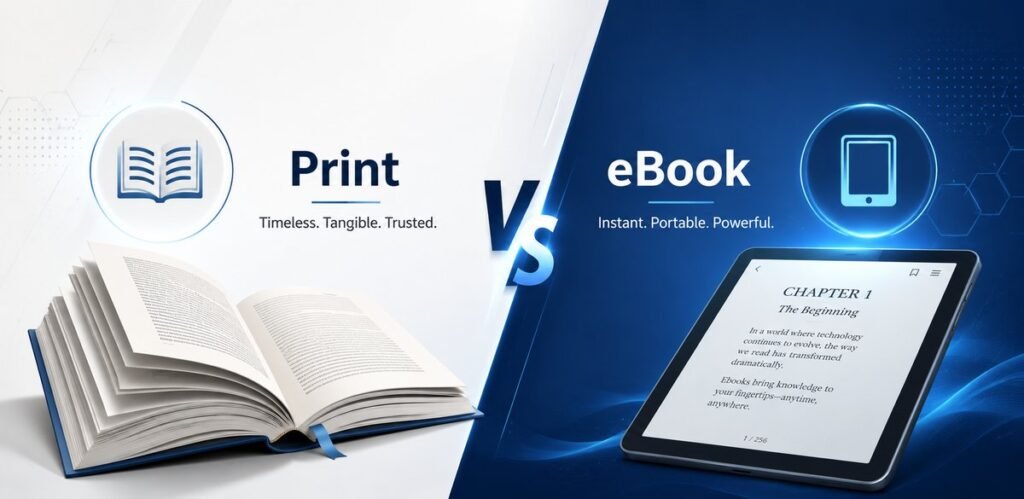
Many first-time authors assume one formatted file works everywhere. It doesn’t — print and digital editions follow different rules, and treating them the same is one of the fastest ways to get rejected by KDP or IngramSpark.
Fixed layout vs. reflowable text
A print PDF is a fixed layout: every page break, line break and margin is locked in exactly as designed. An eBook is built from reflowable ePub or Mobi code — the text re-wraps based on the reader’s font size, screen width and device. A layout that looks perfect as a fixed PDF has to be rebuilt with semantic chapter headings and flexible styling to work as an eBook.
Trim size, margins & bleed
Print books require an exact trim size, specific inner and outer margins, a gutter that adjusts for page count, and bleed settings for any image touching the page edge. None of these concepts exist in an eBook — there is no “page size” on a phone screen.
Typography & page elements
Print interiors typically include running heads, folios, drop caps, and carefully kerned chapter openers. eBooks strip most of this away: no running heads, no manual page numbers, and simplified chapter openers that render consistently across Kindle, Apple Books and Kobo.
Image resolution
Print files need high-resolution images, generally 300 DPI at final print size. eBooks need the opposite: images are compressed and resized for on-screen display, since oversized files bloat the eBook and can cause Kindle to reject it outright.
Table of contents & navigation
A print book’s table of contents is a static list of page numbers. An eBook’s table of contents must be navigable and hyperlinked, so a reader can tap a chapter title and jump straight there. A broken or missing navigable TOC is a common reason Kindle eBooks fail Amazon’s quality check.
Which should you format first?
There’s no universal rule, but formatting the print interior first often makes sense for fiction, since it forces every structural decision to be finalized before it’s adapted into reflowable eBook code. Either way, treat the two files as separate deliverables.